Showing posts with label India. Show all posts
Showing posts with label India. Show all posts
Saturday, 1 February 2014

Thursday, 10 October 2013
We are Confused - Are we really?
Mr. Narendira Modi is the most searched politician in (GOOGLE) India. People in the last six months have started searching news related to election.
Jokes apart, any state, any country which runs on debts, will be a country that seems richer, brighter and modern. one can think of America - the most sought country in the world - the most advanced country in the world, the measure of the world; It had to shut down all of its public offices, parks because it does not have money to pay to its workers. Every month it borrows and pays - well this is how the economy works. Experts will advise me to shut my mouth - they will say everything will be alright soon... This is how I think Gujarat works. This is how Mr. Singh wants it to work for India!
Well Gujarat is like this... what has this to do with the confusion?

The same people who cast doubt about Modi and his innocence in the riot, think that Modi means business.. (One has to ask whose business? and What business?).
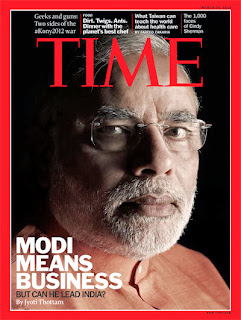
While Mr. Modi is said to be a politician who follows the dictates of the RSS which advocates fanaticism, still he is seen to be a charismatic leader. The citizens of the country know that his silence in the killing of many innocents in the riots. However even the secular citizens wish this time to be on the side of Mr. Modi because he is seen to be a wonderful, powerful, and a productive chief minister in Gujarat - in Gujarat they talk about job opportunities, lot of foreign investments, etc. What is hidden in this illuminated Gujarat is the fact that many things are veiled from the eyes of the public. For example, they say that every third child in Gujarat is underweight. One can add many more things like this. One may look to clear one's prejudice or to know the fact. People search the internet for all sorts of things - unfortunately this may be credited to the favour of Modi - as the most searched politician.
Jokes apart, any state, any country which runs on debts, will be a country that seems richer, brighter and modern. one can think of America - the most sought country in the world - the most advanced country in the world, the measure of the world; It had to shut down all of its public offices, parks because it does not have money to pay to its workers. Every month it borrows and pays - well this is how the economy works. Experts will advise me to shut my mouth - they will say everything will be alright soon... This is how I think Gujarat works. This is how Mr. Singh wants it to work for India!
Well Gujarat is like this... what has this to do with the confusion?
We confuse advancement, modernity, with technology and capitalism and foreign investments. We forget that every country has to develop its own modernity. We think that development has to be in the same way as it happened in America or it happened in Britain. For us economy means, multinational companies, markets, ultimately capitalism. America and other multinational companies come to India not as 'Good willed people' who want to help the Indian economy but to improve their wealth. The fact is that these multinational companies take money from the developing countries to their homeland. Without realizing the fact (at least masking it in the name of development) the government welcomes them with a red carpet, gives them hundreds and thousands of acres of land, gives them water, etc... but for what? - well that is another area that has to be explored.
Imitating the western modernity, we want to see our country develop. All of us want to see our country to develop. But the politicians are in the hands of the West, in the hands of the media, in the hands of the corporate companies. They fund the party and in return the politicians welcome them without ever creating job opportunities for its citizens.
When Mr. Prime minister opened the gates to the corporation companies, the media, the america and everybody saw that he was the man who is ready to help the multinational companies to enter India, now that he has completed his two terms and not much (in spite of all that he has done to the USA and its corporate companies), everybody starts projecting Gujarat's Modi as the efficient leader who can still open the borders for free marketing.
We are blinded by one type of development - we do not see any other.
We are blinded by one type of development - we do not see any other.
Mr. Singh was seen to be one of the 100 most influential figure in the world by TIME. Later when he has not reduced (?) subsidies, not done the reforms as they expected it to happen to India, sing becomes an unwanted figure.

The same people who cast doubt about Modi and his innocence in the riot, think that Modi means business.. (One has to ask whose business? and What business?).

The western mind is fed up with the present prime minister for not letting them as they expected to be. The Indian citizens are not in favour of the present prime minister not because he has not developed the country but because he was not able to provide work, not able to reduce the price hike for food, gas, and light. Therefore the citizens see Mr. Modi and Gujarat as models for the country.
The Westerners and capitalists look for Mr. Modi.
If we as citizens of the country look for Mr. Modi because of price hike, we will have it still higher, because Modi will follow more intense globalized economy than that of Mr. Singh.
Mr. Modi does not have any economic policy that is different from Congress.
Mr. Modi does not have any economic policy that is different from Congress.
Even when secular Hindus, Christians and Muslims look up to Modi to avoid congress, they do not understand that the country will be darker still, not mainly because of religious fanaticism but because of capitalistic fanaticism.
Monday, 22 July 2013
Amartya Sen on Secular India
Nobel laureate Amartya Sen confirmed his hope in secular India that he wishes that a secular person who can make all the citizens of the country feel more secure in the country. He complained that Modi, who is said to the be next prime minister candidate for the BJP in the forthcoming national election in India.
Sen said: "“No, I don’t approve of it... I don’t think the record is very good. I think I don’t have to be a member of the minority in order to feel insecure... We Indians don’t want a situation where the minority feel insecure and could legitimately think that there was an organised violence against them in 2002. I think that is a terrible record and I don’t think Indian Prime Minister as an Indian citizen... Of who has that kind of record. No, I do not.” [the Hindu]
While there are lot of political scientists were critical of secular India, Sen has been on the other end that India should be a secular country. He has confirmed his hope in secularism once again.
Sen said: "“No, I don’t approve of it... I don’t think the record is very good. I think I don’t have to be a member of the minority in order to feel insecure... We Indians don’t want a situation where the minority feel insecure and could legitimately think that there was an organised violence against them in 2002. I think that is a terrible record and I don’t think Indian Prime Minister as an Indian citizen... Of who has that kind of record. No, I do not.” [the Hindu]
While there are lot of political scientists were critical of secular India, Sen has been on the other end that India should be a secular country. He has confirmed his hope in secularism once again.
Monday, 22 April 2013
Religiosity and Richness
Why do
people go to the Temple or praise God? May be, because they have everything in
life. We praise God because we have all the wealth and enjoy all the benefits
of the human world and therefore we are concerned about the higher life. This
would mean that the rich praise God or that praising God becomes possible when
we become rich. In other words, only when our lower needs are fulfilled we will
be concerned about our higher needs. Abraham
Maslow had talked about the hierarchy of needs. If religious belief is
concerned with the higher or fuller life this means that one’s belief is to be
concerned with the higher life. It should mean that only the rich are very
particular to praise God. We hear and read that people throw gold and money in
some famous temples and Churches. The offering can be seen as the sign that
they do not value money so much compared to God and his magnanimity. They are
able to tell God – Money or gold is nothing in front of God –.
On the
contrary we also know that the poor people are more religious than the rich.
Jesus valued the small coin thrown in the offertory box. He also said that there
will be always poor with you. Although he had said this in a different context,
it seems to me that the passage can be interpreted to mean that these poor will
always be there visiting the temple and they will be always faithful. It is
obvious that the poor outnumber the rich in marching towards the temples and
Churches. When one compares a country like India with the Western countries which are quite well off one can very well understand that they do
have less believers and church attendance.[1]
It seems
then that the claim that the rich will seek God seems to be false. God is not
sought only when one is rich but there is something more to belief and not
simply the material welfare. It can be argued that the poor rush to the
Churches in order to seek the material welfare, seeking the help of God to
attain human welfare. If the poor praise God only to receive material goods,
then basic need is not God but my hunger, my clothing and house, in this sense
Maslow may seem to be right. I doubt whether this can simply be associated with
human needs of hunger. There seems to be more to this. The regular attendance,
the affinity to religion can be awakened and one’s explicit identification with
a particular religion can also have sociological or political reasons.[2]
This affinity to religion can be also seen to be inherent in the human
person. That is what some like Paul Tillich called faith as the ultimate
concern of the human person.[3] In
this sense it seems that the economic relations have nothing to do with the
religious beliefs. Poor may be more religious (concerned about the higher life
that is inclusive of the ordinary life) not because they lack wealth but in
spite of lacking wealth. The rich can also be religious in spite of the wealth
they have if they are poor in spirit otherwise the immersion in the world can
block the awareness of the ultimacy. Therefore the awareness of one’s need of
higher life has an easy access in the poor whereas it seems difficult for the
rich.
Does it mean that the poor are really and spontaneously concerned about
the ultimacy and the rich are not? Was Job religious because he was rich – or
because he was poor in spirit? Or he was rich because he was religious? Did he
praise God even when he was poor because he was already poor in spirit – or he
became poor because he prayed?
[1] I restrict myself here to Europe. I do not want to talk about the
United States now. It is true that the United States has more believers and
regular attendance of the liturgical celebrations. There are reasons for the
differences.
[2] In India the celebration of vinayaga sathurthi has become very
popular that can be seen to be associated with the political reasons rather
than religious reasons. The question here is about believers therefore the
question is raised in the religious context and not others.
[3] Paul Tillich calls the faith as the ultimate concern of the person.
Wednesday, 13 February 2013
Secularism Hanged !
India is known to be a secular country which does respect
all religions, their worldviews. The ‘neutrality’ can be seen to be the best
options available for a secular state. Many events in Indian politics have
shown that this neutrality of the government is in theory rather than in practice.
One could argue that it is better to be in papers than nothing at all. Confidently
some may argue that a ‘kind totalitarian’ is better than a ‘ruthless secular
state’. However, it is unthinkable for a modern man to think of monarchy, or
totalitarian regime however kind and loveable the rulers are. It is a [?]
historical impossibility to throw away the democratic elements of our
polity. It is then important that we constantly purify the brutal aspects of
theoretically democratic and practically undemocratic elements of the State.
One issue to show how sometimes most respected secular
states can fail to establish its own secularity is the case of Afzal. Afzal
Guru was hanged recently in Tihar Jail in India without the knowledge of his
wife and his son. What is important here in the case of Afzal Guru is to pay
attention to the verdict: “In its over300 page judgement
the apex court said, ‘The incident, which resulted in heavy casualties, had
shaken the entire nation and the collective conscience of the society will only
be satisfied if the capital punishment is awarded to the offender.’”[1]
The invoking of the collective conscience is important
because it means that whole nation is traumatized at what happened in December
2001 – an Attack on the Parliament when the B.J.P. was ruling the country.
Afzal Guru was seen to be the culprit although there were no evidences to
suggest that he was either directly or indirectly involved in the attack. The
judges invoked the ‘collective conscience of the society’. The collective
conscience of the society does not definitely include the Muslims of the nation
but mostly of the Hindus. The point is when one raises voice against the
verdict or the brutal hanging of Afzal, those citizens will be seen not to
belong to the ‘collective conscience’ and therefore not as members of the
country. Should I consider myself to be part of the collective conscience? It
was invoked because the case was one of the rarest of its kind in the country –
an attack on the pillar of the nation and Democracy.
In order to satisfy the majority collective conscience, the
government / Court has executed the verdict soon after the refusal of the mercy
petition by the President of the country. The B.J.P. leaders had earlier raised
slogans like “Desh abhi sharminda hai, Afzal abhibhi zinda hai", which
means (in stirring rhyme), "Our nation is ashamed because Afzal is still
alive.”[2] The B.J.P cannot raises
slogans like this in the coming election, because Afzal is no more. The
congress will gain popularity also among the Hindus. While all others will keep
silence since it will be against the collective conscience. What has been done openly by the B.J.P is done quietly by the Congress: the difference between
both kinds of ‘Hindutva’ is the mode of operation – open and secret.
Going beyond evidence and to invoke collective conscience is
not new. In the Ayodhya case the honorable judges invoked ‘faith and belief’.
To this many like Ashgar Ali have
responded who said: “Tomorrow other judges motivated by their faith may use
this judgment as a precedent and deliver other judgments invoking faith….Thus,
stretching the argument … in a democracy after all numbers count and so faith
of majority community will play greater role than faith of minority community
and court of law will thus become majoritarian in their attitude and all the
legal values and protection of minorities and their faith in the constitution
may be ultimately subverted.”[3]
This raises the question whether a secular state can really
be secular forgetting one’s own faith at all in the functions. Will it be
possible for the citizens or the responsible office holders to use ‘the veil of
Ignorance’ of John Rawls? It seems not... Our deep and ultimate concerns keep
coming in different ways.
Although there were gaps in the evidences and arguments, the
country needed a perpetrator who will be hanged and in whom the vengeance can
be thrown. It can mean that what is stake is the ‘scape goat mechanism’. Girard
says: “In the evolution from ritual to secular institutions men gradually draw
away from violence and eventually lose sight of it; but an actual break with
violence never takes place.”[4]
For the unity and to satisfy the collective thirst for
revenge a perpetrator was hanged and our thirst is quenched. May be joining
with Arundhathi Roy, one may rightly ask: “Now he has been hanged, I hope our
collective conscience has been satisfied. Or is our cup of blood still only
half full?”[5]
[3] Asghar
Ali Engineer (2010): “Ayodhya judgment – triumph of faith or constitutional
legality?” accessed on 19th October on http://www.csssforum.org/default.as…
As quoted in http://www.lebret-irfed.org/spip.php?article450
[4]
Rene Girard, Violence and the
Sacred, trans. Patrick Gregory
(Baltimore and London: The John Hopkins University Press, 1972 [4th
1984]), p. 307.
Thursday, 6 December 2012
Religious Harmony !
December
6th is a black day for the Indian Democracy. Whatever be the motive for the
demolition, I do not know whether this act can be justified. Those who
initiated this brutal act may have their reasons and the other party may still
have resentment to counter attack. What happens often is that any event, sometimes even a political blunder or some vested interests of the politicians are often identified with religion and therefore they are seen to be religious conflicts rather than the blunder of some politicians or fundamentalism.
All of us do know
that religions, irrespective of their place of origin, keep Love as their
central teaching.
Everyone thinks
that his religion is the greatest. His religion is the truest and the purest. I
do not think that this is wrong. When one believes he accepts a particular
creed because it is meaningful to his life. But communicating one’s religious
truth often ends up in violent conflicts. One wants to prove his religion’s
love and non-violence by violence. Proving one’s love through violence can
never be possible.
Comparative
studies have shown that non-violence is the foundational teaching of all
religions. Mere writings about the message of love or non-violence cannot
reduce the religious conflicts. It can be done only with the believers’ act of
trust and love. One has to trust the other and more love the other forgiving
the mischievous deeds of the other. Only when we find someone transcending the
act of rebellion and revenge, trust can be built.
Unless this
love is taken to heart
and we trust and respect and love one another,
we will
not be able to live as true believers.
Friday, 19 October 2012
A Stranger is not a Stranger
It was 14th October 2012. I was travelling from Germany in a
train. I could not speak German well since it is not my mother tongue. Very few suffer like me. But many today speak in many languages as though using the ‘shift’ key in a
computer. I find it difficult to switch between three languages. I wonder how people do that between five and six.
I was hesitant to
start a conversation with a stranger who was sitting next to me because he was speaking in German with some of his friends. Another wonder with the system of the railways, when you
book the ticket together you do not get adjacent seats. You find always a stranger inside.
You have to personally and verbally request the stranger to change the place.
In India they ask you to even change coaches. Here they are very hesitant even
to request to sit in the next seat. What is given is given – but it also means
that they do not want to intrude in what is given to them. More, one does not
know how the other would react.
I was already a stranger in the train, and still a remote stranger
between the companions who traveled together. Even with a stranger who is
doubly alienated, a conversation could be initiated. It starts from silence. who said one needs language to communicate? A peaceful silence that has a smile normally kicks off with a common, agreeing
note like mamma mia – che caldo! Or what a bright and sunny day? Well if there is no smile, then there is no conversation. Even if there were to be one it will be
cold, hard, and strict NO.
I had already smiled and he reciprocated it. After
entering Austrian the border we started speaking about the rivers that flow, the climate, and the European Union. He and I shared the same feeling that this union could be a model for other continents in living together irrespective of different languages. I told him that India too has a model - which house different languages and culture. He thought that India has a single language. It was a revelation for him to know that the north Indians do not understand the south Indians and vice versa.
India is a country but European Union is not.
... To be continued ...
India is a country but European Union is not.
... To be continued ...
Thursday, 13 September 2012
Democracy and Demonstration
India is a country partly ruled by the majority, partly ruled
by the law. It gives an equal status to all the citizens of the country yet it
tries to fulfill the wish of the majority. In the synchronizing model [of both
Republic and democracy], the sufferers are the people because they do not have
either control over the rulers or do not receive what they are supposed to
receive by the benefit of the law. It is also because the law is in the hands
of the few and sometimes dictated by the rulers themselves.
In the continuous protest that we witness in Tamil Nadu, one can hope to explain the complexity of the phenomenon. The rulers see the manifestation of the people as irrational and as a divisive factor that goes against the rational decision of the majority. The vast majority of the people are made to rationally believe that the nuclear plant is the only option available to the continuous 'power cut' they experience in the country. Joining hands with the rational belief of the government and the indifferent majority, the 'media' [some of them] makes a propaganda writing against the protests of the people for their‘collective good’, say the safety of the present and future generation. They write that these manifestations do show that the protesters are against the unity of the country.
The truth is that some rulers, and a pillar of democracy in fact do not understand that India is also a country that values
the protection of every citizen. They think that demonstrations and protests are dangerous to the unity of the nation. They are against the demonstrations only to create an
opinion of the majority. They do not understand that these protests are the sources
that strengthen the system of the Indian governance in which every body’s right
can be protected. It is only the recognition of these protests that strengthen the
unity of the country.
Only
when the voices of protests such as these are not respected and the recognition
is suppressed, then there emerges a danger of division. The voice for fragmentation may become stronger when the collective rights of the people are not respected.
Therefore those who
oppose a legitimate protest should understand that by supporting a majoritarian
decision or the silent acceptance of the decision made by the majority, they are only perpetrating
the system of tyranny and not of ‘democracy’ which seems their conviction.
Subscribe to:
Posts (Atom)